
What color eyes will the baby have?
11.11.2013
Children's department
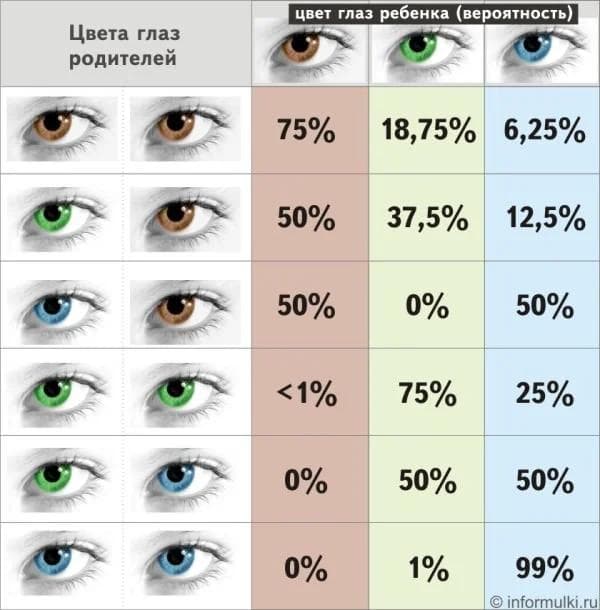
Genetics decides it all. There are many combinations of genes that we inherit from both parents, and they determine eye colour. Below is a simplified chart that can help you roughly predict your future child's eye colour.
What determines eye colour
Eye colour depends on the amount of the pigment melanin in the front layer of the iris. A lot of melanin gives brown eyes, a little gives grey or blue eyes, and an intermediate amount gives green or hazel eyes. Several genes are involved rather than one (the most important are OCA2 and HERC2), so eye colour cannot be predicted exactly — only as a probability.
When a baby's eye colour settles
Most babies are born with light, grey-blue eyes: melanin builds up in the iris gradually after birth. Most of the change happens in the first 6–12 months, and the final colour usually settles by the age of 2–3.
Simplified probability chart
These figures come from a popular simplified model and are not an exact forecast. The real result may differ, because eye colour depends on many genes and on which genes the parents inherited from their own parents.
- both parents brown-eyed: brown ≈ 75%, green ≈ 19%, blue ≈ 6%
- brown and green: brown ≈ 50%, green ≈ 38%, blue ≈ 12%
- brown and blue: brown ≈ 50%, blue ≈ 50%, green — rarely
- green and green: green ≈ 75%, blue ≈ 25%, brown — less than 1%
- green and blue: green ≈ 50%, blue ≈ 50%
- blue and blue: blue ≈ 99%, green ≈ 1%
Can light-eyed parents have a brown-eyed child?
Rarely, but it happens: the model above is simplified, and some genes can boost pigment production. Likewise, two brown-eyed parents can have a blue-eyed child if both carry the relevant genes.
When to see a paediatric ophthalmologist
Eye colour changing during the first year of life is normal. See a paediatric ophthalmologist if:
- the eyes are different colours (heterochromia) or the colour has changed in one eye only;
- the pupil looks white or grey, or "glows" in flash photos;
- one pupil is larger than the other, an eye turns, or the child squints;
- the colour of the iris has clearly changed in an older child or adult.
These signs do not always mean disease, but they are worth checking at an examination by a paediatric ophthalmologist.
Your child can have this examination at the children’s ophthalmology department of our centre.
Book an ophthalmologist consultation online
Pick a convenient time in the web account or the mobile app — no waiting for a call
Frequently Asked Questions
The article explains: eye color genetics, inheritance and gene combinations from parents. It helps patients understand what to pay attention to and when an ophthalmologist consultation is needed.
No. The material is informational. Self-treatment may be unsafe because similar symptoms often have different causes.
Book an examination if symptoms recur, worsen, affect vision, or if you need a decision about surgery, laser treatment or medication therapy.